Single Issue Buildings - Why They Can Be Better
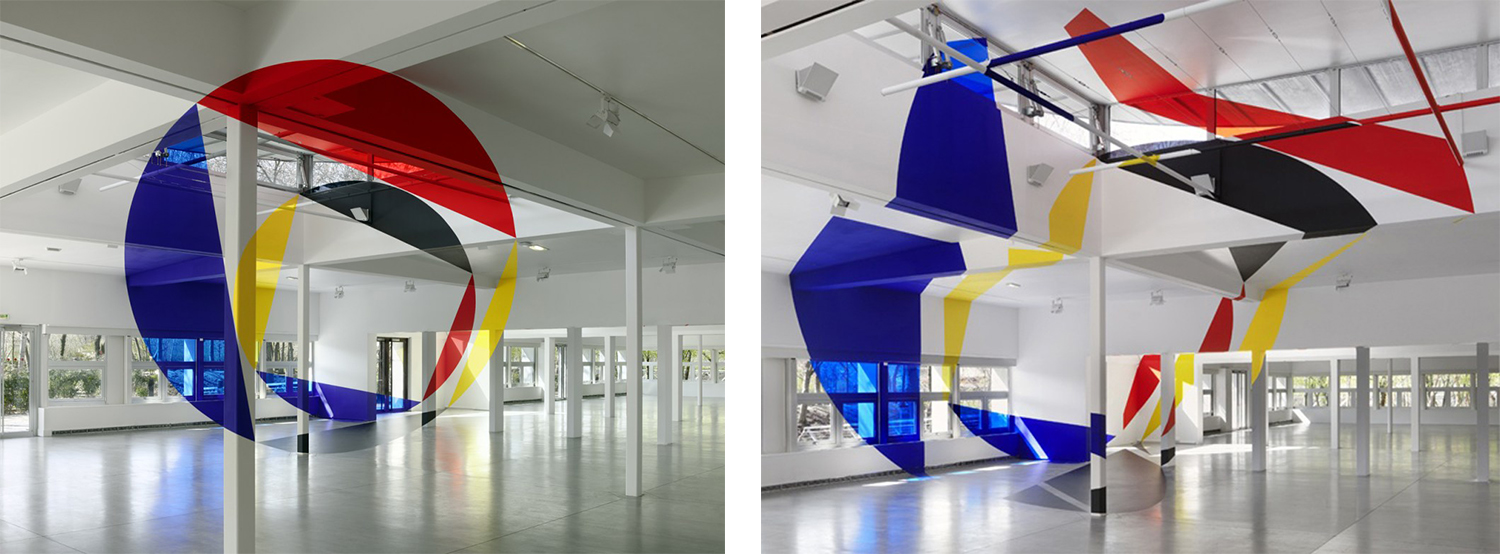 Beautiful spatial illusion painting by Felice Varini, “Rouge jaune noir bleu entre les disques et les trapezes” (2015)
One thing I've noticed, with the rise of "Instagram" or "Pinterest"-driven design, is the proliferation of single issue buildings. Single issue buildings only work on one scale, or one level, or one "metric" of success. Beyond that perfect perspective shot, or beyond that level of "zoom", the project completely falls apart...and I really dislike that. Maybe it's just me, but architects should be designing WHOLE spaces, WHOLE environments, and WHOLE experiences. We are not paid to only consider things at one particular level (well, I guess you can say we aren't really paid that well at all, anyways). But designing things to only work at a certain "level" makes sense, because it's usually easier, cheaper, and faster. Who cares that the back alleyway doesn't fit with the rest of the building? No one will walk there. Why do you consider a shot from there? Nobody CARES, as long as the money, marketable shot WORKS compositionally. But that's the thing -- you SHOULD care, because you are professionally the owner of the design intent. If you don't care, NOBODY ELSE CARES. And thus you abdicate responsibility, to the GC or the developer, and the design falls apart.
I want to separate what I consider "single issue buildings" with "prioritization". Yes, truly, there will always be more important spaces, compared to service spaces, and there will always be building "fronts" and building "backs". Certain design issues will always be more important than others ones. The nuance here, is when "single issue buildings" completely abdicate the responsibility to take care of all the other secondary and tertiary design concerns --- when you consciously object to thinking about anything else, besides the big, spectacular parti. I believe that people always know, when a design is not driven by holistic concerns, or when a design was created through one specific perspectival lens ONLY. Because once you start walking away from the "right corners", the building just looks bad.
Again, I attribute this phenomena to the rise of digital design. Computer-aided design, and their tools, often "flatten" our perception of things. We believe that the images displayed on our machines are the whole reality, although they are merely composed fragments. I think that the past 30 years (in the time since postmodernism) have been an uneasy learning curve, with projects guided by a misunderstanding, or a mis-handling, of computer tools. From parametric blobs to Revit-template cookie-cutter buildings, we have yet to really master these new-fangled tools of the trade, seduced by the computer's promise of speed and virtual reality. For architecture students, sometimes it feels like playing with fire --- we have yet to understand the basics of real space itself, let alone the physics and mechanics of virtual space. And so, with an incomplete spatial understanding, coupled with an incomplete understanding of digital tools, we go out into the world to try to build something great, only to be disappointed by gravity, or the strength of our GPUs...
Like great cities, great buildings are multi-layered, and at each scale of experience they say something new and coherent. Buildings like Le Corbusier's National Museum of Western Art in Tokyo, or Zaha Hadid's MAXXI in Rome, achieve this type of wholeness that goes beyond the "single issue", or the "single perspective". You have to really be in the space, to really understand them -- not just look at a perspective photo, or a single diagram. There is flow, rotation, and a clearly defined design intention that also feels open-ended. Creating these masterpieces requires more than a clear photoshop trick, or a nice marketing slogan -- they seem to take experience, vision, intuition, and years and years and years of hard work. And ultimately, I think people will know, and can tell the difference, between "deep" and "shallow" design, between mastery and "single issue" works.